Blog
Tax Technology and Tax Automation for Tax Teams
BY Heather Teicher
October 20
Tax Technology and Tax Automation for Tax Teams
Your best people did not train for years to re-type numbers off a PDF. Yet that is where tax season goes.
The pressure is not new. Volumes climb, staffing does not, and the calendar refuses to move. The instinct is to hire your way out of it. But the real constraint is rarely the number of people. It is how tax data moves through your shop.
This is where tax technology earns its place. Modern tax automation software does not replace the professional who signs the return. It removes the transcription, reconciliation, and hand-offs that eat the hours those professionals should spend on judgment. Below, we define what tax technology means for a tax team, show where automation actually fits across the tax data lifecycle, and explain where a purpose-built platform like K1x belongs in your stack.
Key Takeaways
- The constraint is usually the operating model, not the headcount – and the CPA pipeline is roughly a third smaller in first-time candidates than it was in 2016.
- Automation delivers at every lifecycle stage: intake, extraction, validation, mapping, and filing.
- Purpose-built, tax-first automation beats general AI where accuracy and defensibility matter.
- K1x is the private-market tax-data layer – K1 Aggregator, K1 Creator, and 990 Tracker – integrating with your existing tax engines under SOC 2 Type II controls.
What Is Tax Technology for Tax Teams?
Tax technology is the software and automation that carries tax data through its lifecycle – intake, extraction, validation, mapping into returns, and filing – with far less manual keying. For a tax team, tax automation software converts inbound documents into structured, reviewable data, so people spend their time on positions and review rather than transcription.
In plain English, it is the difference between a person copying a K-1 into a return by hand and a system reading that K-1 and handing the reviewer clean, mapped data to check. The professional still owns the judgment. The machine owns the typing.
This Is an Operating-Model Problem, Not a Staffing Problem
Here is the reframe that changes everything. When the work backs up, most teams reach for more headcount. But the talent to hire is thinning. There has been roughly a one-third decline in first-time CPA Exam candidates since 2016, according to the AICPA. The pipeline you are counting on is smaller than it was.
So the honest question is not “how do we find more people to do the manual work?” It is “why is so much of this work still manual?”
Treat it as an operating-model problem and the path opens up. A tax operation is a data pipeline with review gates. When the pipeline is built on re-keying and email attachments, adding people only adds coordination cost. When the pipeline is automated, the same team absorbs more volume without more late nights. Tax workflow automation is how you scale capacity that headcount alone cannot buy – roughly 3 to 5 times the volume without adding staff.
Where Automation Fits Across the Tax Data Lifecycle
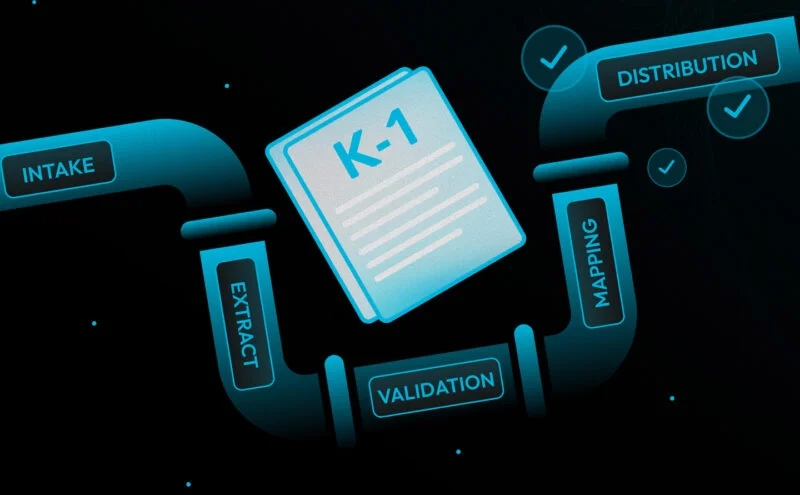
Automation is not one switch. It is a set of gains at each stage of how tax data moves. Map your own process against these five stages and you will see where the hours actually leak.
1. Intake
K-1s, 1099s, and W-2s arrive in every format imaginable, from portals, email, and paper. Automated intake gathers them in one place instead of scattering them across inboxes and shared drives.
2. Extraction and digitization
This is the biggest manual sink. A single K-1 can take 15 to 45 minutes to key by hand, and manual entry carries roughly a 1 to 4 percent error rate. Purpose-built extraction reads the document and turns it into structured data – a standard K-1 in under 11 seconds at better than 99 percent accuracy.
3. Validation and review
Clean structured data changes the review job. Instead of eyeballing totals and hunting footnotes, reviewers work from surfaced figures with exceptions flagged. The judgment stays human; the busywork does not.
4. Mapping into returns and tax engines
The second re-keying risk is moving numbers into the return itself. Automation maps extracted data straight into the tax engine, so the figure a reviewer approved is the figure that files.
5. Filing and distribution
At the end of the pipeline, K-1s must be issued and returns filed. Automation runs issuance and e-filing from one place rather than assembling documents one at a time.
General AI vs. Purpose-Built, Tax-First Automation
Not all automation is equal, and this distinction matters for anyone who signs a return. General AI is trained broadly. It is fluent, but it is not accountable to a tax form, and it does not know that Box 20 code Z is a different animal from code N.
Purpose-built, tax-first automation is designed around the actual documents. It knows the Schedule K-1, the K-3, the 1099, the W-2, and the Form 990. It maps their fields into tax engines with controls suited to work that gets signed and filed. For tax data, the question is not whether a tool is clever. It is whether it is right, repeatable, and defensible.
Where K1x Fits: The Private-Market Tax-Data Layer
Private-market data is where the manual pain concentrates. Alternative investments generate tens of millions of K-1s each year, and every one carries footnotes, state detail, and codes that a spreadsheet cannot police. K1x is built for exactly this layer of the stack. It digitizes, distributes, and decodes private-market tax data so it feeds the rest of your tax operation cleanly.
Three products cover the private-market lifecycle:
- K1 Aggregator ingests and extracts inbound K-1s, 1099s, and W-2s, turning them into data that flows into returns.
- K1 Creator issues and distributes K-1s for funds and partnerships.
- 990 Tracker handles 990 and 990-T preparation and e-filing for exempt organizations.
None of this asks you to leave your tax engine. K1x connects to the tools you already run, including GoSystem Tax RS, CCH Axcess, UltraTax, Lacerte, and ProSystem fx, so extracted data lands in the return instead of being re-typed.
Because this is sensitive client data, the security posture is not an afterthought. K1x is SOC 2 Type II, with encryption in transit and at rest, role-based access control, and tenant isolation across the workflow.
Manual vs. Automated: The Same Work, Two Operating Models
The contrast is clearest stage by stage. The figures below reflect K1x platform performance on standard K-1 processing.
| Tax data lifecycle stage | Manual / spreadsheet process | Automated with K1x |
| Intake of K-1s, 1099s, W-2s | Documents arrive by email and portal; staff sort and re-key from PDFs | Documents ingested centrally; data extracted from any format |
| Extraction / digitization | 15-45 minutes of manual keying per K-1; ~1-4% keying error | Sub-11 seconds per standard K-1 at 99%+ accuracy |
| Validation / review | Reviewers eyeball totals and chase footnotes by hand | Structured data surfaced for review; exceptions flagged, not hunted |
| Mapping into returns / tax engines | Numbers re-typed into the return, a second re-keying risk | Data flows to GoSystem Tax RS, CCH Axcess, UltraTax, Lacerte, ProSystem fx |
| Filing / distribution | K-1 issuance and 990 e-filing assembled document by document | K-1 issuance and 990 / 990-T e-filing run from one platform |
| Capacity effect | More volume means more headcount or more overtime | 3-5x capacity without added headcount; 50-90% less processing time |
Teams that make this shift commonly report on the order of 311 percent ROI with a break-even around four months.
Who This Is For
Tax technology of this kind pays off wherever private-market data volume outruns the people available to process it:
- Heads of tax operations who own throughput and cannot solve it with headcount alone.
- Tax directors at funds and corporates drowning in inbound K-1s each season.
- Firm partners who need capacity to grow without proportional hiring.
- Fund controllers responsible for issuing and distributing K-1s on a deadline.
- Exempt-organization teams managing 990 and 990-T preparation and e-filing.
See what tax automation looks like on your own K-1 data.
Bring a real partnership pack and watch it move through intake, extraction, and mapping in minutes. Book a Demo
The Bottom Line
You will not hire your way past a shrinking talent pipeline. You will out-operate it. Treat your tax function as a data pipeline, automate the stages that are still manual, and choose automation that is built for the documents you actually file. That is what modern tax technology is for.
Frequently Asked Questions
What is tax technology for tax teams?
It is the software and automation that moves tax data through its lifecycle – intake, extraction, validation, mapping into returns, and filing – with less manual keying, so professionals spend time on judgment rather than transcription.
Is tax automation the same as replacing accountants with AI?
How is purpose-built tax automation different from general AI?
What does K1x automate for private-market tax teams?
Does tax automation software integrate with existing tax engines?
Is the platform secure enough for sensitive tax data?
Sources
- AICPA & CIMA, Trends in the Supply of Accounting Graduates and the Demand for Public Accounting Recruits (CPA Exam candidate pipeline).
- Journal of Accountancy, “The accounting graduate pipeline: Where do things stand?” (2025).
- K1x, product and platform performance data (accuracy, processing time, capacity, ROI), company-sourced.
- K1x, security and compliance (SOC 2 Type II, encryption, RBAC, tenant isolation).