Blog
K-1 Data Processing: AI-Powered Automation for High-Volume Tax Teams

BY Scott Turner
March 17
K-1 Data Processing: AI-Powered Automation for High-Volume Tax Teams
The 2026 filing season is approaching, and if your team processed thousands of K-1s last year using spreadsheets and manual data entry, you already know what’s coming. The good news: there’s a better way. This guide walks you through modern K-1 data processing workflows, the technology driving them, and how to transform your tax operations before the next busy season hits.
What Is K-1 Data Processing and Why It Matters in 2026
Schedule K-1 data processing encompasses the entire lifecycle of handling these critical tax documents—from the moment a PDF lands in your inbox to when the extracted data flows into your tax software and client deliverables. With the IRS reporting over 40 million Schedule K-1s issued annually , and K-3 international reporting adding layers of complexity since TY 2021, the volume and difficulty of this work continues to climb.
At its core, K-1 data processing involves intake of PDFs and scans, extraction of line items and supplemental data, validation against prior-year information, normalization into consistent formats, and delivery into downstream systems. The forms themselves—1065 K-1s from partnerships, 1120-S K-1s from S corporations, and 1041 K-1s from trusts—serve as the primary reporting mechanism for private equity funds, venture capital, real estate syndications, and hedge funds.
The pain is real and measurable. Manual K-1 data entry takes 30-45 minutes per form when you account for tracking down supplemental statements, keying state-source income, and double-checking QSBS or Section 199A deductions. Multiply that across 5,000 to 50,000 K-1s for mid-to-large accounting firms and fund administrators, and you’re looking at thousands of hours consumed by repetitive work every tax season.
K1x exists specifically to solve this problem. As an AI-powered tax technology workspace built for private markets tax data, our platform digitizes, distributes, and decodes the documents that matter most to your clients. Tools like K1 Aggregator® and K1 Creator® handle the heavy lifting of extraction and production, allowing staff to focus on review, analysis, and advisory work rather than data entry.
This article prioritizes practical guidance first. You’ll learn how to process K-1s faster and more accurately, then dive into the specific automation capabilities and workflows that make it possible.
Core Challenges in Modern K-1 Data Processing
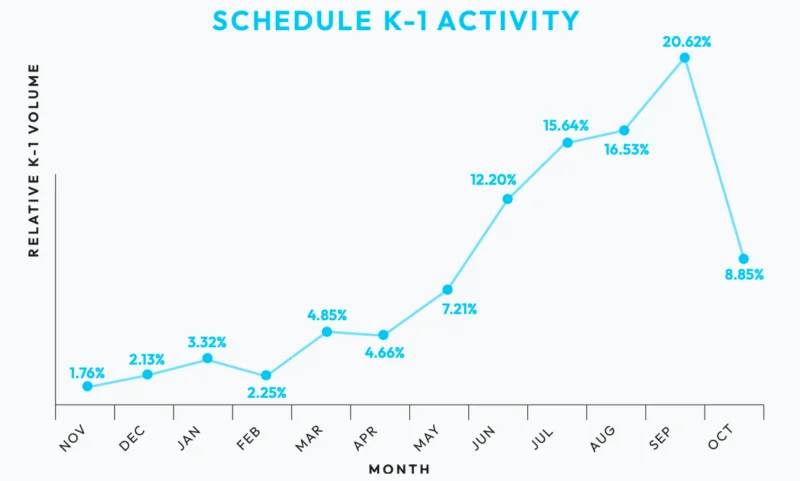
Busy season no longer means just January through April. For firms handling private markets clients, the real crunch now stretches from January through October as late K-1 and K-3 delivery, amended forms, and state notices keep teams working well past traditional deadlines.
Document Variability Creates Chaos
Every general partner and fund administrator seems to have their own K-1 format. Some use clean, standardized PDFs. Others send scanned images with handwritten annotations, multi-page supplemental statements, and capital rollforwards buried in footnotes. This variability makes template-based OCR nearly useless—you can’t build a rule for every possible layout across thousands of issuers.
Schedule K-3 Adds International Complexity
The introduction of Schedule K-3 (first required for TY 2021) fundamentally changed international reporting requirements. Partners now receive detailed foreign tax credit information, withholding calculations, and country-by-country breakdowns that must be accurately captured for federal compliance. Many firms still struggle to extract and validate this data efficiently.
Operational Fragmentation Slows Everything Down
Consider the typical intake process: K-1s arrive via email attachments, GP portal downloads, secure file transfers, and occasionally paper mail. Tracking which K-1s have arrived, which are missing, and which need corrections becomes a spreadsheet exercise that consumes hours of administrative time. For family offices and wealth managers with clients holding 50+ fund investments, this tracking challenge alone can derail tax season timelines.
Error Risks Carry Real Consequences
Mis-keyed state source income. Overlooked QSBS adjustments. Incorrectly entered foreign tax credits. These errors don’t just mean rework—they can trigger notice letters, amended returns, and reputational damage with UHNW clients or institutional investors. Industry data suggests 2-3% error rates in manual processing can lead to significant downstream problems.
The traditional approach—spreadsheet-driven tracking combined with manual keying—simply doesn’t scale to tens of thousands of forms while maintaining accuracy. An integrated, AI-assisted tax data operations model offers a fundamentally different path forward.
The K1x Approach to End-to-End K-1 Data Processing
K1x is a dedicated private markets tax data operations platform, not just an extraction widget bolted onto generic document processing. Our focus remains on the specific documents that drive complexity for accounting firms, fund administrators, family offices, and tax-exempt organizations: Schedules K-1, K-3, 1099, W-2, and 990.
K1 Aggregator® Powers High-Volume Processing
K1 Aggregator® automates intake, extraction, normalization, and export of K-1 data at scale. The system supports multiple input channels and filetypes:
- PDF documents (native and scanned)
- Image files from scans or mobile capture
- Email attachments routed directly into processing queues
- SFTP folders for automated batch uploads
- The industry-first Digital K-1 (.K1x) format carrying structured data from issuer to recipient
This flexibility means firms can centralize all private markets tax documents in a single environment rather than juggling isolated tools for different form types.
Real-World Scale in Action
Consider a university endowment office managing investments across 500+ fund positions, generating 10,000+ downstream K-1s each year. Using K1 Aggregator®, their team can process, validate, and export this volume in a fraction of the time required by manual methods—freeing resources for the analysis and reporting that actually requires professional judgment.
The platform supports collaboration across your team. Multiple staff members and partners can review, annotate, and approve K-1 data inside the workspace rather than passing spreadsheets and PDFs through email chains. This creates transparency, maintains control, and builds a complete audit trail.

AI and Machine Learning in K-1 Data Extraction
K1x’s patented AI and machine learning technology differs fundamentally from simple template OCR. Our models perform layout-agnostic extraction, meaning they identify and capture data regardless of how a particular issuer formats their K-1. This capability has been continuously refined through real tax seasons processing millions of documents.
What the AI Extracts
The system identifies and labels standard fields across 1065, 1120-S, and 1041 K-1 forms:
| Field Category | Specific Data Points |
| Partner Information | Name, TIN, address, ownership percentage |
| Federal Income | Ordinary income, rental income, capital gains, Section 199A QBI |
| Credits & Deductions | Foreign tax credits, state tax credits, deductions by category |
| State Reporting | State-source income, apportionment factors, withholding amounts |
| Supplemental Data | Footnotes, capital account rollforwards, special allocations |
The handling of supplemental statements and footnotes is crucial. Many K-1s include state-by-state income schedules, composite return flags, and detailed breakdowns that multistate practices need for complete compliance.
Continuous Learning with Governance
K1x models are trained on a large corpus of private markets tax documents, then refined through a secure feedback framework. When reviewers correct fields, the system learns patterns without exposing client data. This differs from vendors who advertise “no training on your data”—we focus instead on governed, client-approved model improvement under strict contractual and technical controls.
Data integrity features include:
- Confidence scores flagging uncertain extractions
- Exception queues routing questionable items for human review
- Prior-year comparison checks highlighting unusual changes (sudden ownership drops, missing foreign tax lines)
These capabilities ensure your team catches issues early rather than discovering errors during client review.
Designing a Scalable K-1 Data Processing Workflow
Tax operations leaders need a blueprint they can actually implement for the 2026 filing season. This section provides that framework across the January-October processing window.
Workflow Stages
A standardized K-1 workflow moves through six distinct stages:
- Document Intake: GP emails and portal downloads route into a dedicated K-1 inbox or secure drive connected to K1 Aggregator®
- Classification: System identifies form type, tax year, and entity to organize processing
- Extraction: AI captures all relevant fields from the document
- Validation: Automated extraction results checked against prior-year totals and known positions
- Review: Staff examine flagged exceptions and approve final data
- System Integration: Clean data exports to tax prep software, workpapers, and reporting tools
Best Practices for Implementation
Centralize intake immediately. Stop having staff forward K-1 attachments ad-hoc. Route everything through a single channel that feeds directly into your processing system. This eliminates lost attachments and creates a complete document trail.
Consider a dedicated K-1 pod. Rather than distributing K-1 processing across your entire team, designate a specialized group using common rules, templates, and checklists inside the K1x workspace. This maintains consistency across clients and builds deep expertise.
Build validation checkpoints. Cross-check extracted data against:
- Prior-year K-1 totals
- Partnership capital rollforwards
- Known state filing positions
- Expected ownership percentages from client records
Exceptions should be flagged for senior review rather than hidden in spreadsheet tabs where they’re easily overlooked.

Integrations, Exports, and Downstream Use of K-1 Data
Accurate, structured K-1 data powers far more than tax compliance. The same information drives investor reporting, performance analysis, and deep risk analysis for private markets portfolios.
Export Options for Every Use Case
K1x transforms K-1 data into formats your downstream systems need:
- Excel and CSV workpapers for custom analysis and client deliverables
- Direct API pushes into tax prep systems for automated form population
- General ledger imports for fund accounting and partnership allocations
- Data warehouse feeds for analytics platforms built on modern infrastructure
Integration Patterns That Scale
The platform supports common integration approaches:
| Pattern | Use Case |
| Nightly SFTP drops | Batch processing for firms with overnight reconciliation workflows |
| REST APIs | Real-time data delivery to tax software and reporting tools |
| Configurable mapping layers | Translate extracted fields to each firm’s internal data model |
These patterns ensure K-1 data reaches leading tax compliance suites, portfolio accounting platforms, and data lakes without requiring custom development for each connection.
Beyond Filing Returns
K-1 data enables analytics that create significant value for clients:
- Dashboards showing K-1 arrival status across all client portfolios
- Exposure analysis by state or country for compliance planning
- QSBS and Section 1202 tracking for entrepreneurs with qualified small business stock
- Monitoring of complex items like 988 transactions
K1x serves as the central tax data layer for private markets. To see how this works with your specific K-1 volume, contact our team to request a demo or book a test drive using your own documents.
Governance, Security, and Compliance for K-1 Data Operations
K-1 data contains some of the most sensitive information your organization handles: Social Security numbers, TINs, capital account balances, and detailed income allocations. Regulators, institutional investors, and audit committees in 2025-2026 expect robust controls around this data.
K1x Security Posture
The platform implements enterprise-grade protections:
- Encryption in transit and at rest for all documents and extracted data
- Strict access controls limiting who can view, edit, and export information
- Comprehensive audit logs tracking every action on every K-1
- Role-based permissions allowing appropriate access for staff, managers, and partners
Meeting Institutional Expectations
Accounting firms, fund administrators, and tax-exempt organizations (universities, hospitals, foundations) use K1x to implement standardized retention policies and defensible documentation trails. The platform supports data residency requirements and contractual obligations common among institutional clients.
Our onboarding and training programs help firms embed governance practices directly into their K-1 workflows—not as an afterthought, but as a core component of operations.
Looking ahead, governance and security will increasingly differentiate K-1 automation vendors. Firms should evaluate partners on more than just extraction accuracy; the ability to demonstrate robust controls matters just as much for future proof operations.
Measuring ROI and Next Steps with K1x
Treat K-1 data processing as a measurable tax data operations program, not just a seasonal fire drill. The firms that approach it this way consistently outperform those that rely on ad-hoc manual processes.
Calculating Your ROI
Key metrics for quantifying automation value:
| Metric | Manual Baseline | Automated Target |
| Time per K-1 | 30-45 minutes | 2-5 minutes |
| Rework/Amendments | 2-3% of forms | <0.5% of forms |
| Return delivery cycle | Weeks after K-1 receipt | Days after K-1 receipt |
| Staff capacity | Consumed by data entry | Freed for advisory work |
Before implementing automation, benchmark your current state: forms processed per preparer, cycle time from receipt to sign-off, and known error rates. These baselines make projected improvements concrete rather than aspirational.
Get a Tailored Analysis
K1x offers to build a customized ROI analysis using your firm’s specific K-1 volumes, staff mix, and technology stack. We typically need:
- Annual K-1 volume by form type
- Current staffing allocation during busy season
- Existing tax software and integration requirements
- Specific pain points (state complexity, K-3 volume, late arrivals)
Your Next Steps
Ready to modernize your K-1 operations? Here’s how to move forward:
- Request a live demo using real client K-1s to see extraction accuracy firsthand
- Book a hands-on test drive of K1 Aggregator® with your team
- Engage with our onboarding team to design a pilot for the next tax season
- Get your ROI analysis to build the business case for stakeholders
K1x specializes in private markets tax data processing—it’s our complete focus, not a side feature. The next busy season will arrive faster than you expect. The firms that invest in automation now will have resources available for the advisory work that actually differentiates their practice.
Don’t let another tax season pass with your team buried in manual data entry. Request to speak with a K-1 automation expert to start transforming your K-1 operations today.